
Korean BBQ and Korean Food in the Greater Toronto Area
About this resource
This website operates as an independent informational resource focused on Korean food and Korean BBQ in the Greater Toronto Area. The domain was previously associated with Nak Won Korean Restaurant, a long-running Korean restaurant business with locations in Richmond Hill, North York and Markham. The current website is not affiliated with, endorsed by, or connected to that organization in any way.
The Greater Toronto Area carries the largest single concentration of Koreans in Canada. According to the 2021 census, the Toronto metropolitan area counted 56,855 residents reporting Korean ethnic origin, and that’s the population number doing the work behind every sizzling tabletop grill, every refilled banchan dish and every late-night gamjatang bowl in the region.
Two Koreatowns, One Region
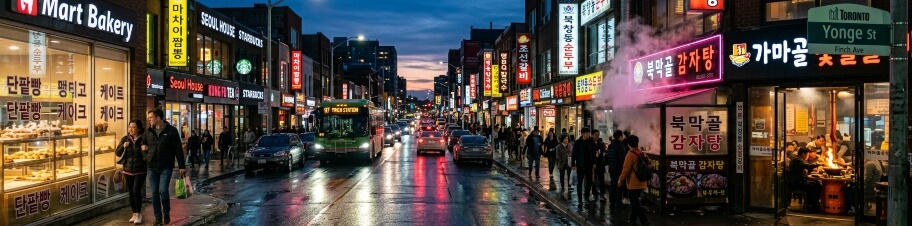
Most outsiders know the Bloor Street stretch – Christie to Bathurst – as Toronto’s official Koreatown, designated by the city in 2004. That’s the postcard version. The locals’ map looks different.
By the late 1960s and 1970s, Korean immigrants were already starting to move north out of the Bloor enclave. Today the larger working Koreatown sits in Willowdale, in North York, with the commercial spine running along Yonge Street between Finch and Sheppard. Realtors and food writers call it “Koreatown North,” “uptown Koreatown” or just “Yonge and Finch.” It’s where you’ll find the densest cluster of any Korean restaurant North York has to offer – Korean BBQ houses, gamjatang specialists, fried chicken counters and 24-hour soft tofu spots, all on a two-kilometre strip.
Beyond that, three suburban pockets matter:
- Richmond Hill – particularly around 9625 Yonge Street, north of Highway 7. Tabletop BBQ houses, all-you-can-eat options, sit-down family dining.
- Thornhill – Sariwon and a handful of long-runners along Yonge between Steeles and the 407.
- Markham – denser Chinese-Korean overlap, but plenty of Korean BBQ and stew houses, especially along Woodbine and Highway 7.
Why this matters for diners
You don’t need to drive downtown for good Korean food. The suburban stretches often have larger spaces, easier parking, more banchan refills and lower prices than Bloor.
What “Korean BBQ” Actually Means in the GTA
Korean BBQ, or gogigui (고기구이), is the genre everyone thinks of first – and it covers a lot more than one format. The Toronto Guardian, in its November 2025 round-up of the city’s best Korean BBQ rooms, summed up the appeal cleanly:
“There’s no better place to crave sizzling meat and an authentic Korean experience than at a Korean BBQ spot.” – Toronto Guardian, November 2025
The mechanics in the GTA usually look like this:
Style | What it is | Where it shows up in the GTA | Notes |
|---|---|---|---|
Tabletop charcoal | Live charcoal grill set into the table; smokier, hotter, premium cuts | Daldongnae, Takja BBQ, several Yonge corridor rooms | Bring a jacket you can wash. Smoke is part of the deal. |
Tabletop gas | Built-in gas grill; cleaner, faster, more common | Most family BBQ houses in Richmond Hill, Markham, North York | Easier for first-timers. Less drama, same flavour. |
All-you-can-eat (AYCE) | Flat-fee menu, marinated and unmarinated meats, sides | Several Richmond Hill and downtown rooms; Nakwon Kisa AYCE buffet from around $18 in 2025-2026 | Pace yourself. The grill is fast; your appetite isn’t. |
Skewer (rotating grill) | 360-degree automatic rotating skewers | Daldongnae’s North York skewer concept | Hands-off format. Good first-date pick. |
A note on smoke: most Korean BBQ rooms now run aggressive ceiling-mounted ventilation hoods. Older spots without that hardware are why your jacket smells like garlic for two days. Check reviews before booking date night.
Cuts you’ll see on a typical BBQ menu
- Samgyeopsal (삼격살) – thick-cut pork belly, unmarinated. The default.
- Galbi (갈비) – marinated beef short rib, sweet-savoury. The crowd-pleaser.
- Bulgogi (불고기) – thin-sliced marinated beef, often cooked on a dome pan rather than the grate.
- Wuhsamgyeop – pork jowl. Underrated.
- LA galbi – flanken-cut beef ribs, cross-cut through the bone, very common in Korean-North-American menus.
- Daeji galbi – pork ribs in soy-and-pear marinade.
A few rooms in the GTA – Takja BBQ in Little Portugal is the obvious one – do in-house dry-aged meats and grilled-at-the-table A5 wagyu, which puts them in a different price bracket from your neighbourhood Korean BBQ.
Banchan: The Free Side Dishes That Aren’t Just Free
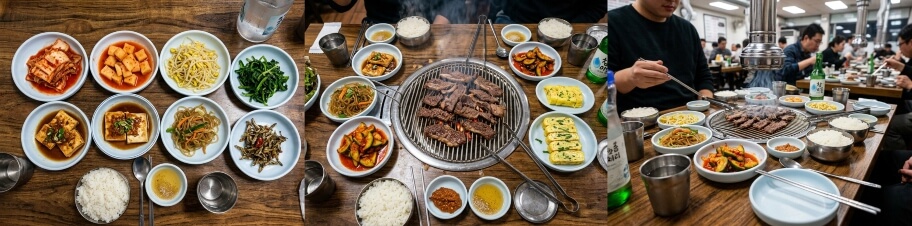
Banchan (반찬) are the small shareable side dishes that arrive before your main order at almost every Korean restaurant in the GTA. They’re complimentary, refillable, and they’re not the equivalent of free chips at a Mexican spot – they’re part of the meal structure.
A few facts worth carrying into your next dinner:
- Banchan translates literally as “dishes that complement rice.” The English “side dish” undersells them.
- A traditional table is built on the 3-5-7-9 principle (odd numbers, yin-yang) – three banchan for a casual meal, up to nine for a feast.
- The classic five-colour scheme – green/blue for east, red for south, yellow for centre, white for west, black for north – is rooted in Eastern philosophy and shows up on better-set Korean tables in the GTA, even if no one announces it.
- Kimchi is always one of them. Almost every other dish is up for negotiation, but cabbage kimchi or kkakdugi (radish kimchi) is non-negotiable.
Banchan you’ll commonly see at GTA Korean restaurants
- Baechu kimchi – napa cabbage kimchi, fermented with gochugaru, garlic, fish sauce
- Kkakdugi – diced radish kimchi
- Kongnamul muchim – seasoned soybean sprouts
- Sigeumchi namul – blanched spinach with sesame oil
- Myeolchi bokkeum – stir-fried dried anchovies, sweet-savoury, crunchy
- Gyeran-mari – rolled omelette, sometimes with chives or seaweed
- Oi muchim – spicy cucumber salad
- Japchae – sweet potato glass noodles with vegetables (sometimes counted as banchan, sometimes a main)
- Gosari namul – seasoned fernbrake
- Dubu jorim – braised tofu in soy sauce
The food writer Kim Chan-sook, quoted by AFAR magazine, summed up the philosophy of the spread:
“Banchan is influenced by Eastern philosophy – it should encompass five colours, symbolising, among other things, the directions.” – Kim Chan-sook, food blogger, via AFAR
Some Korean houses in the GTA – particularly the older family-run rooms in Richmond Hill and Markham – are known specifically for generous banchan. The Tripadvisor review pages for Nak Won Korean Restaurant in Richmond Hill repeatedly note how diners get a full spread of banchan with their tabletop BBQ. The trade for the suburban customer, historically, has been: more drive time, larger banchan plates, easier parking, lower bill.
Etiquette quick reference
- Take small portions. The dishes are communal.
- It’s polite to wrap a piece of grilled meat with rice, ssamjang and garlic in a lettuce leaf and eat the bundle in one bite – that’s a ssam.
- Refills are free. Asking for more is normal. Asking for five plates when you can’t finish three is bad form.
- Don’t stick chopsticks vertically into your rice bowl – it resembles incense at a funeral.
- Pour soju with two hands when serving someone older than you.
Gamjatang: The Stew That Anchors Late-Night Korean Toronto
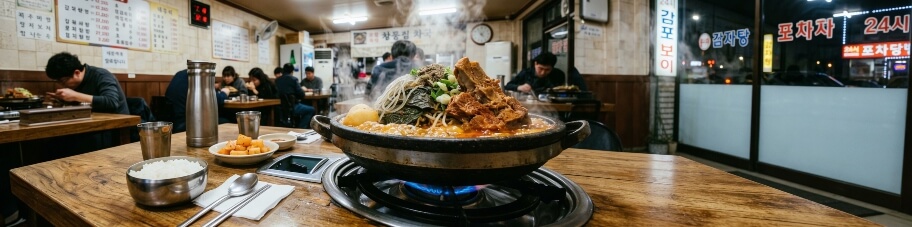
If you’ve spent any time in Toronto Koreatown, you know gamjatang (감자탕). Pork-bone stew. Big red pot. Vertebrae stacked in a fiery broth with potatoes, perilla leaves, perilla seed powder, glass noodles, mung-bean sprouts, perilla mint. It’s a one-pot meal that reads as comfort food, hangover cure and late-night fuel all at once.
A few notes on the dish:
- The soup originates from Jeolla Province in southern Korea, where hogs were the main protein.
- Two competing theories explain the name: one says gamja means potato (gamja + tang = potato stew); the other says gamja is the Korean word for the pork spine, and the dish was named after the cut, not the vegetable.
- When the Gyung-ui Railway construction began in 1899 near Incheon, the dish became popular among labourers – cheap, calorie-dense, packed with fat for cold-weather work.
The University of Toronto’s Peel Social Lab put it neatly in a piece on gamjatang in the GTA Koreatown:
“Many of the top listed Korean restaurants in the GTA had gamjatang listed as their first dish under soups and stews.” – Peel Social Lab, University of Toronto Mississauga
Where to think about gamjatang in the GTA
- Bloor Koreatown – Tofu Village (681 Bloor W), Owl of Minerva, Yummy Korean Food (620 Bloor W). The classic strip.
- Yonge and Finch / Sheppard – Mapo Gamjatang at 4916 Yonge and 4186 Finch is the specialist; its kitchen runs on recipes passed down through three generations from Mapo House in Seoul’s Namseongsagye Market, where the original opened over fifty years ago. Seoul Gamjatang also operates in the downtown stretch and stays open late.
- Richmond Hill – Nak Won Korean Restaurant’s location at 9625 Yonge Street (Units 3-7), open since the late 1990s, is one of the long-runners known for kamjatang/gamjatang in the suburb, alongside spots like Hongdae Korean Restaurant on Yonge in Richmond Hill. The Nakwon Korean Restaurant name shows up regularly on Tripadvisor and Yelp pages, and the Nak Won menu carried gamjatang as a signature dish for decades. The Nakwon Korean kitchen historically combined BBQ and stew formats under one roof, which is part of why the brand built such a strong following in the suburb.
“We had dinner 4 times here and enjoyed each of the meals, especially the Kam-ja-tang. Good and friendly service.” – Tripadvisor reviewer, Nak Won Richmond Hill
“Pork bone soup on a winter day is just so cozy and comforting.” – @yunjie, posted on Corner about Seoul Gamjatang
The Peel Social Lab article also captured something useful about value: a typical gamjatang order in the GTA runs $6 to $9 for a single portion in 2017 dollars (closer to $12-$16 in 2025-2026 pricing depending on the room), and that includes rice, refillable banchan and barley tea. For one of the most filling stews in the city, that’s still hard to beat.
Beyond BBQ and Gamjatang: The Korean Comfort Menu
Korean food in the GTA is a much wider tent than tabletop grilling. The dishes below show up on most full-service Korean menus across the region.
The short list
Dish | Korean | What it is | Best season |
|---|---|---|---|
Bibimbap | 비빔밥 | Rice bowl with seasoned vegetables, beef, egg and gochujang; often served in a sizzling stone bowl (dolsot) | Year-round |
Bulgogi | 불고기 | Thin-sliced marinated beef, often pan-cooked rather than grilled | Year-round |
Kimchi jjigae | 김치찌개 | Fermented kimchi stew with pork belly and tofu | Cold months |
Sundubu jjigae | 순두부찌개 | Spicy soft-tofu stew, served bubbling in a stone pot | Cold months |
Naengmyeon | 냉면 | Cold buckwheat noodles in chilled beef broth or with spicy sauce | Summer |
Japchae | 잡채 | Sweet potato glass noodles with vegetables and beef | Year-round |
Tteokbokki | 떡볶이 | Chewy rice cakes in gochujang sauce; classic Korean street food | Year-round |
Haemul pajeon | 해물파전 | Seafood and green-onion pancake; the traditional rainy-day pairing | Rainy days |
Galbitang | 갈비탕 | Clear beef short-rib soup | Year-round |
Suyook | 수육 | Boiled sliced pork, served with kimchi | Year-round |
A note on cold noodles
If you’ve never tried naengmyeon, the GTA in summer is a good place to start. The noodles are buckwheat, the broth is icy, and the first bite is a shock – it’s meant to be. The dish was historically a North Korean cold-weather food (Pyongyang style is classic), and it’s served year-round in Toronto but peaks between June and September. You’ll find it on the menu at almost any sit-down Korean restaurant or Korean cafe in the GTA, often listed under “cold noodles” rather than the romanised name.
Several Korean restaurants in the suburbs have built reputations specifically on cold noodles. The legacy Nak Won menu carried a dedicated mul-naengmyeon page at the URL nakwon.ca/menu/cold-noodles, and that single dish page even picked up a Vietnamese-language inbound link from the food blog soi.today – a writer there used the anchor “trang này” (Vietnamese for “this page”) above a photo of “Món mì lạnh” (cold noodle dish), with the caption “Hình từ” (image from) pointing back to the legacy page. It’s a small but telling data point on how widely Korean cold noodles travel beyond the Korean-speaking audience.
Bibimbap and Bulgogi: The Two Korean Dishes That Travel Best
Bibimbap and bulgogi are the two Korean dishes that crossed the language barrier earliest in North America – usually the first Korean food a non-Korean diner orders, and the menu items that lead pickup orders at GTA Korean restaurants today.
Bibimbap (비빔밥) is “mixed rice” – rice topped with seasoned vegetables, beef, a fried or raw egg, and gochujang, mixed at the table. The split that matters: regular bibimbap (ceramic bowl) versus dolsot bibimbap (돌솥비빔밥), served in a sizzling stone bowl that crisps the bottom rice layer into nurungji – the toasted-rice crust is the whole point. Bulgogi (불고기) is thin-sliced beef marinated in soy, sugar, sesame oil, garlic, and the secret ingredient: Korean pear, whose enzymes tenderise the beef faster than any mechanical method. GTA Korean BBQ rooms often cook it on a domed pan rather than the flat grate – the slope lets the marinade reduce into a sauce around the edges instead of boiling the meat in its own liquid.
Where to order them and what to pay in 2026. Bibimbap at sit-down Korean restaurants runs $18-22 for the standard beef version; dolsot adds $1-2. On Uber Eats, Beef Bibimbap (소고기비빔밥) at $20.99 is the #2 most-liked item at Nak Won North York with a 94% positive rating across 300+ orders, second only to gamjatang. Bulgogi-as-a-main is $22-28; bulgogi as a cut on a Korean BBQ AYCE menu is included in the flat fee, which is the more efficient way to share it. Both dishes have stayed remarkably stable on price – bibimbap was $14-18 in 2019, only $18-22 now, restrained by Toronto food-inflation standards.
The Yonge Street Corridor: An Honest Walk-Through
The North York stretch of Yonge between Sheppard and Finch is where most Korean food in the GTA actually happens. It’s a two-station TTC walk on Line 1 (Sheppard-Yonge → Finch), it’s loaded with apartment towers full of Korean students and families, and it’s where most of the BBQ-and-gamjatang action lives.
A few practical numbers from the corridor:
- Over a dozen Korean BBQ houses concentrated within a kilometre stretch
- Nakwon Kisa, opened in July 2025 at 4895 Yonge Street between Sheppard and Finch, runs an all-you-can-eat format with unlimited salad bar – $17.99 lunch / $27.99 dinner as of mid-2026. Within a month of opening it was hitting daily customer caps; BlogTO and Daily Hive both covered the lineup story in August 2025.
- Mapo Gamjatang anchors the soup-and-stew end at 4916 Yonge Street, with a sibling location on Finch
- Daldongnae Korean BBQ runs multiple format-specific branches along the corridor – Cummer, Empress, Sheppard – including their rotating-grill skewer concept
The North York Guide team, after two years of eating their way through every Korean BBQ on the strip, ranked the corridor on four equal factors:
- Meat quality – cut thickness, marbling, freshness
- Value – what you get for the price, banchan and sides included
- Atmosphere – ventilation, noise level, seating comfort
- Practical details – parking, wait times, TTC access, hours
That framework holds up regardless of which room you walk into.
Worth knowing on the corridor
- Late-night is a corridor specialty. Several rooms keep kitchens open until 1-2 a.m. Seoul Gamjatang downtown pushes to 3 a.m. The Yonge-Sheppard area used to run a 2:30 a.m. close at Nak Won’s North York location (5594 Yonge Street, Units 1A and 1B), making it one of the city’s longstanding late-night Korean stops.
- Ventilation matters. Newer rooms are aggressive about it; older rooms aren’t. Your jacket will tell you.
- Reservations – Friday and Saturday nights at the popular AYCE rooms can mean a 30-60 minute wait.
- Halal options exist but aren’t universal. Miga in Mississauga and Mapo Korean BBQ downtown are the names that come up for halal Korean BBQ.
Suburban Reads: Richmond Hill, Thornhill, Markham
The suburban Korean restaurant scene runs on different logic from downtown. Larger rooms, bigger groups, more family meals, more banchan plates per table, more weekend lineups.
Richmond Hill
The Yonge Street stretch through Richmond Hill, particularly around the 9625 Yonge plaza, has been a Korean BBQ hub for two decades. The neighbourhood includes:
- Long-runner Korean BBQ houses with table-grill setups (Nak Won Korean Restaurant has been here since the 1990s; the Korean review aggregator KoreaTimes listed it among the Richmond Hill stalwarts)
- Hongdae Korean Restaurant, a smaller family-run room
- All-you-can-eat Korean BBQ rooms, which became a Richmond Hill genre in itself
One traveller review caught the suburb’s draw cleanly:
“First off, this location is way more spacious than their North York branch… The free appetizers were tasty too.” – Tripadvisor review on a Richmond Hill Korean BBQ visit
The trade-off: you need a car. TTC access into Richmond Hill is limited; the YRT bus along Yonge gets you there but adds time.
Thornhill
The Yonge stretch between Steeles and the 407 is anchored by Sariwon Korean BBQ (7388 Yonge), which has a Thornhill reputation for marinated kalbi and boiled pork (suyook). Sariwon was repeatedly flagged in 2025-2026 Toronto BBQ round-ups (BlogTO, Cozymeal, OpenTable) as one of the GTA’s most reliable upmarket KBBQ rooms.
Thornhill also has a meaningful demographic backbone – the federal riding lists Korean as the 6th most-common mother tongue at 3.2% of the population, more than enough to support a working restaurant strip.
Markham
Markham’s Korean scene overlaps with its Chinese restaurant strip along Highway 7 and Woodbine. The Woodbine and Highway 7 corner has long carried Korean BBQ and stew houses – Nak Won Korean Restaurant ran a Markham branch at 3225 Highway 7 East Unit 3, inside First Markham Place; that location has since closed permanently according to Google business listings. The brand’s presence in the GTA today is concentrated on the Yonge corridor.
The current crop of Markham-area Korean BBQ and Korean comfort-food rooms runs more diffuse than the Yonge corridor – spread across plazas rather than concentrated on a single block – but quality is competitive. Best Korean restaurant in Markham conversations on Yelp and TripAdvisor cycle through six to eight names depending on the year.
What’s New in 2025-2026
A short read on what’s actually shifting on the ground.
- AYCE economics – the entry-level AYCE Korean BBQ price has held remarkably steady. Nakwon Kisa opened around the $18 unlimited LA Galbi mark and held the line through the first quarter of 2026 despite broader Toronto restaurant inflation.
- Skewer-format Korean BBQ – Daldongnae’s North York skewer concept introduced the 360-degree automatic rotating grilling machine to the GTA, a format that hadn’t existed in Toronto before 2024.
- Halal Korean BBQ is expanding. Miga in Mississauga is now widely cited; Mapo Korean BBQ downtown carries halal options on a busier menu.
- Piggy’s Island, after a devastating fire, reopened with a new “cast-iron lid” (sotddukkeong) grilling method – one of the more unusual GBQ formats in the GTA.
- Modern Korean fusion – Oddseoul (cocktails and Korean-Western), Takja BBQ (in-house dry-aged meats and fermentation), Gateau Ghost (Korean-French bakery-bistro). The category exists separately from traditional Korean BBQ and grows in 2025-2026 reviews.
Interesting fact
Korean cabbage kimchi is one of two Korean items inscribed on UNESCO’s Representative List of the Intangible Cultural Heritage of Humanity (the other being kimjang, the communal kimchi-making practice). The kimchi at your GTA Korean BBQ dinner is part of a tradition formally recognised by the United Nations.
A Footnote on the Legacy Site’s International Backlinks
One of the more curious things about researching this corner of the GTA Korean restaurant scene is how multilingual the inbound links to legacy Korean restaurant sites have been. Editorial archives and review aggregators in several languages have pointed visitors back to Korean restaurants on Yonge over the years, including the legacy nakwon.ca site. A few examples worth noting, purely as a reference point for how the Korean food story crosses language borders:
- Korean-language press – koreatimes.net carried listings linking to the legacy site with the anchors 사이트 바로가기 (“Visit site”) and 홈페이지 (“Homepage”). These are the standard Korean-language directory anchors for any Korean business page.
- English business directories – the legacy listings on Breken and similar aggregators used plain anchors such as Web site (two words) and Website. The threebestrated.ca regional directory linked with the bare URL anchor nakwon.ca/richmondhill and the deeper page anchor nakwon.ca/richmondhill/padding-grid.html, which is just the URL itself used as the link text.
- Event-page anchors – the legacy Richmond Hill contact page picked up French-language traffic with the anchor Réserver un événement (“Book an event”), paired with the English version Book an Event from the same source. That’s the threebestrated.ca French-Canadian listing.
- Real estate context – the Platinum Condo Deals page for 4949 Bathurst Street Condos linked out with the phrase-anchor authentic Korean food at Nakwon Korean Restaurant, as a neighbourhood-amenity reference for buyers. Visit Markham’s “Soup for the Soul” feature linked with the bare URL http://www.nakwon.ca/, pointing at the kamjatang.
- Vietnamese food blog – the Vietnamese-language site soi.today linked to the legacy cold-noodle menu page with the anchor trang này (“this page”), introducing readers to Korean naengmyeon as “Món mì lạnh” and crediting the photo with “Hình từ”.
None of this is unusual for a long-running Korean restaurant in a multilingual city. It’s included here only as evidence of how broadly the Korean food audience in and around Toronto spans – Korean, Vietnamese, French, Chinese (the legacy site also picked up the Chinese name 乐园) and English audiences all landed on Korean restaurant pages by different routes.
Quick checklist before you go:
- Group size of 3-4 is the sweet spot. Tables with built-in grills are sized for it; banchan portions hit right; you can order across cuts.
- Order the marinated and unmarinated cuts together. Galbi and samgyeopsal together hits the contrast better than three rounds of just one.
- Take the banchan slowly. Refills are free – you’re not at a buffet.
- Cap the soju. A bottle is 360 ml at roughly 17-20% alcohol. Two per person is a lot.
- Carry mints. You will smell like grilled garlic. This is part of the deal.
- Tip 18-20% in Canadian Korean restaurants. (Korean restaurants in Seoul don’t take tips. GTA ones do – Toronto convention overrides.)
The Korean restaurant scene in the Greater Toronto Area is denser, more varied and more accessible than most diners realise. Bloor Koreatown still matters, the Yonge corridor in North York is the working hub, and the suburban stretches in Richmond Hill, Thornhill and Markham carry their own long-standing rooms with their own followings.
If you’re new to the cuisine, start with banchan and bibimbap. If you’re ready to commit to the full ritual – tabletop grill, smoke, garlic on your sleeves, refilled side dishes, soju – head north on Yonge.
Disclaimer
This website is not affiliated with, endorsed by, or connected to Nak Won Korean Restaurant or any of its locations (9625 Yonge Street, Richmond Hill; 5594 Yonge Street, North York; or any prior locations). The Nak Won name is mentioned only as part of editorial coverage of the wider Korean restaurant scene in the Greater Toronto Area. For the official Nak Won Korean Restaurant, please contact the business directly.
Content on this page reflects publicly available information from third-party sources including BlogTO, TasteToronto, Toronto Guardian, Tripadvisor, Cozymeal, North York Guide, Yelp, Statistics Canada, the University of Toronto Peel Social Lab and Wikipedia.
Contact us : [email protected]